Serbian Alphabets: Cyrillic, Latin and more

4 Serbian Alphabets: Cyrillic, Latin and more

People often wonder what alphabet is used in Serbia: is it Cyrillic or Latin? How do we write in Serbia today? Do you have to learn the Cyrillic script?

Need a quick 0 boost? We get you approved instantly—no long wait, no hidden fees. Simply fill out the short online form, and if you’re eligible, the money lands in your account within minutes. It’s perfect for covering surprise bills or urgent expenses while keeping your credit score intact. get your 0 loan in minutes and say goodbye to stress—because life moves fast, and so can your finances.

There’s a common misconception that the Latin alphabet is used in Croatia, while the Cyrillic is used in Serbia. But the truth is that in Serbia we simultaneously use both scripts and alphabets.

The Serbian children learn both Cyrillic and Latin alphabet and script, both block and handwritten styles, in the first two grades at all primary schools in Serbia.

Do you wonder how we got there and how it all started?

I will illustrate this development through a brief review here, giving you the most important information.

If you happen to dislike history, please jump over to the final section entitled

“Serbian Alphabets Today“.

Glagolitic Alphabet – Glagoljica

Let us look back at the 9th century, when the first Slavic alphabet is believed to be invented. Its creators were probably St Cyril and his brother St Methodius, who used the new writing system to translate the Bible into Old Slavic. Old Slavic or Old Church Slavonic was the first Slavic literary language and was supposed to become the lingua franca of all the Slavs.

The original name of this alphabet was actually most probably Cyrillic! The term “glagoljica” (Glagolitic alphabet) that we use today occurred later. It is derived from the old Slavic verb glagoliti, to talk. From the same root we have the word glagol, which means ‘a verb’ in modern Serbian/Bosnian/Croatian.
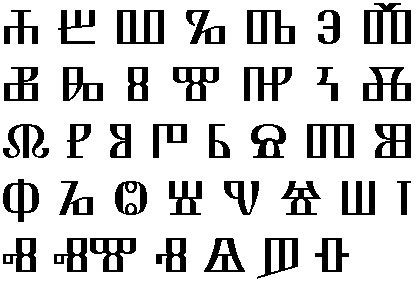
Angular or Croatian Glagolitic Script

It is not known whether this writing system was constructed on the basis of an older Slavic alphabet. The Glagolitic alphabet is the first Slavic alphabet evidenced by many documents in the entire Slavic world, like the famous Codex Zographensis or Zografsko jevanđelje, today kept at the Russian National Library.

The Old Slavic Cyrillic Alphabet

I suspect that the Glagolitic alphabet was quickly replaced only because it was way too complex and therfore it took huge amounts of time to write all the books (the poor monks used to write by hand before the printing machine was invented). Indeed, it is believed that this alphabet was developed by the Saint Cyril’s disciples in the late 9th century. That is the alphabet we today refer to as Cyrillic, ćirilica.

It is based mostly on the Greek alphabet, and some letters for the specific Slavic sounds are based on the Glagolitic alphabet. There are many manuscripts written in this script, such as Miroslav’s Gospel or Miroslavljevo jevanđelje, written in Montenegro during the late 12th century and today kept at the National Museum of Serbia in Belgrade.

Miroslav's Gospel

This writing system and the Old Slavic as the literary language were used in the entire Slavic world for centuries, but every writer was unconsciously adding features of his mother tongue, the language of the common people. That is why in the 12th century we have different recensions emerging (for example Russian recension of the Old Slavic or Serbian recension of the Old Slavic).

That is also how Serbia had developed diglossia, or more accurately polyglossia. This is to say that the common people spoke their native language and dialect, while the Church used the Srpskoslovenski language (the Serbian recension of the Old Church Slavic), the Serbian schools in Austro-Hungarian empire were introducing the Russian recension with the teachers and books coming from Russia, while the Serbian intellectuals were speaking and writing the Slavjanoserpski language, a solemn mixture of the common Serbian and the Russian Old Slavic recension. 

Serbian Alphabets: Cyrillic

The understanding for the need to write in the common native language emerged in the late 18th century, and culminated in the work of Vuk Stefanović Karadžić in the first decades of the 19th century.

He was the guy who made our life simple by simplifying the Old Cyrillic alphabet and adapting it to the Serbian phonetic system. He kept 24 letters from the old alphabet, rejected those that were not pronounced in Serbian, borrowed 3 letters from different sources, and invented 2 new letters. That is how the modern Cyrillic alphabet originated.
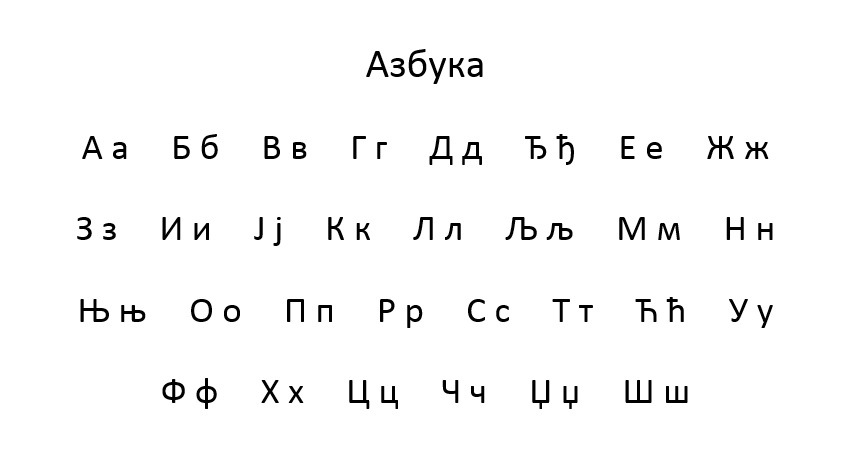
While the writing system as a way of writing or a font is called ćirilica – ћирилица, all the Cyrillic letters in their specific order are called azbuka – азбука.

Serbian Latin Script and Alphabet - latinica i abeceda

Serbian Alphabets: Latin

The Latin script nowadays used equally in Serbia was developed from the first Croatian Latin script originated by Ljudevit Gaj. It was meant to bring together Slovenians, Croatians and Serbians living in Austro-Hungarian empire at the time.

That is why it includes both Č and Ć (most Croats do not distinguish these two sounds; Slovenians in their modern script do not have the letters Ć and Đ, since they don’t have the corresponding sounds), and that is why it suggested writing Dž, Lj and Nj as digraphs (because Slovenians do not have the [ʤ], [ʎ] and [ɲ] sounds they represent: the Cyrillic Џ, Љ and Њ). The Serbian intellectuals Vuk Karadžić and Đura Daničić took part in the second reforming of it (the latter is known to have invented the letter Đ).

The script and the way of writing is called latinica, while the corresponding letters set in their fixed order are called abeceda.
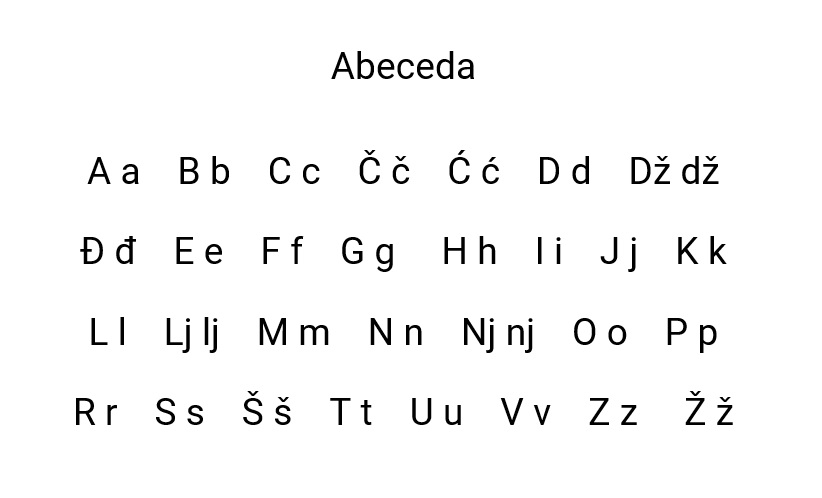
Serbian Latin Script and Alphabet - latinica i abeceda

Serbian Alphabets Today

Throughout the years, there has been this idea that ćirilica is Serbian and latinica is Croatian. (I’d say that latinica is Latin and ćirilica is Slavic, for that matter!) However, I guess that Serbians got used to and adopted latinica much more than Croatians ever did ćirilica. When the countries split, ćirilica was completely rejected in Croatia, while we are continuing to learn and use both writing systems simultaneously and equally.

Serbia is an example of a digraphic country: our Constitution allows for both scripts (even though ćirilica is the official one), and our children learn to use both writing systems from the first grade.

That being said, one look at the Serbian reality will show you that latinica is used even more then ćirilica, both in the streets and (especially) online.

I made some photographs illustrating the simultaneous use of both writing systems. But I have to admit that I had to pick them carefully, because wherever I looked latinica mostly dominated in the streets.

For example, some traffic signs in Serbia are printed in both scripts, but many of them only in Latin.
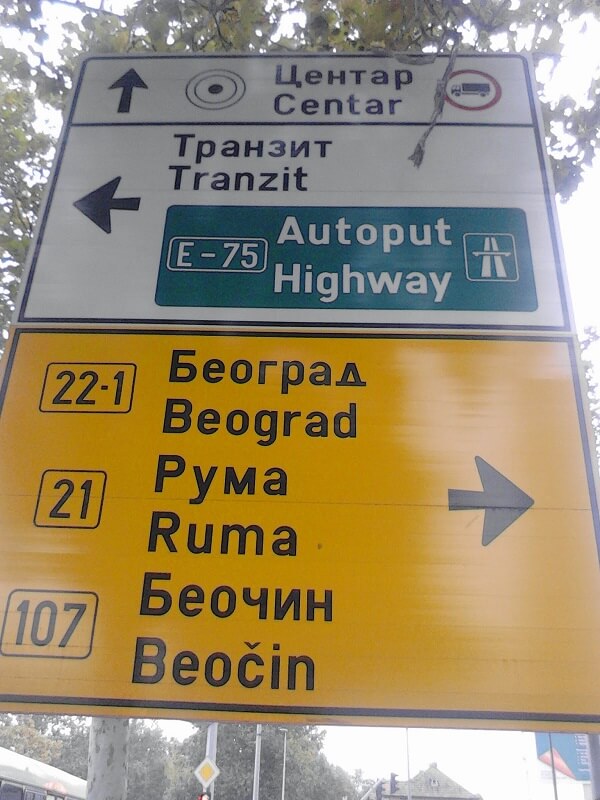
A street sign in Serbia written in Cyrillic and Latin Script
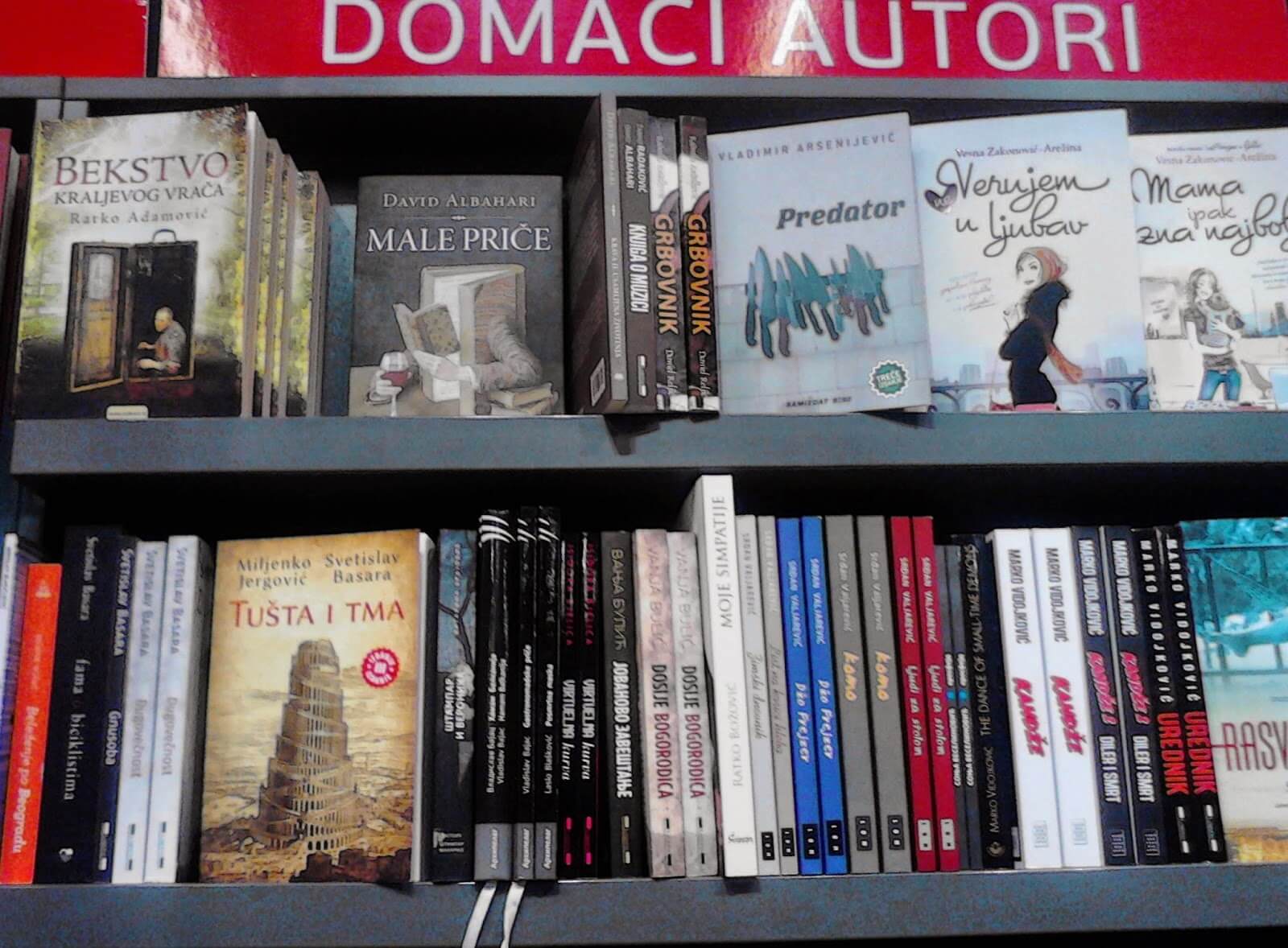
A bookshop in Serbia with books in Cyrillic and Latin Script

The books and magazines in Serbia are printed in both scripts, but during the last decades, they are published predominantly in the Latin script. Virtually only new editions of some Serbian classics may be found in Cyrillic.
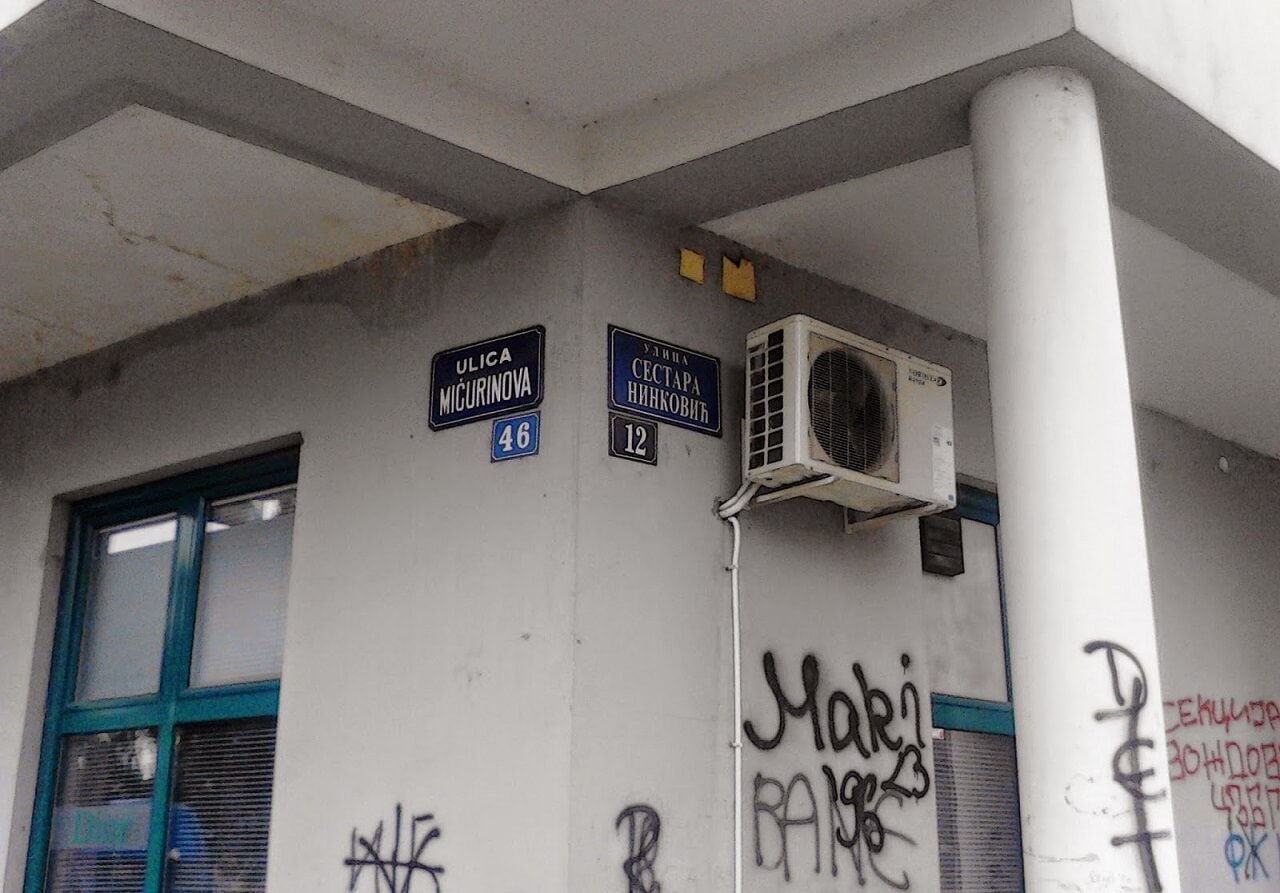
Street signs and graffitti in Serbia written in Cyrillic and Latin Script

This one is my favourite! Here you can see the names of the two streets in Novi Sad, one next to another, in the two scripts, and several graffiti written in both scripts as well.

Should you learn both Serbian Alphabets, Latin and Cyrillic?

Not surprisingly, my advice is to learn both scripts. Have no second thoughts! They both work on the same principle, they even have some common letters.

Getting used to the Cyrillic script will take you some time and practice, but it is not difficult, really. And you will be proud when you start reading all the signs and ads in the Serbian streets with ease.

But if you also learn the handwritten or cursive styles of both Serbian alphabets, the feeling will be glorious: you will be able to read anything written in this part of the world.

Copyright © Magdalena Petrović Jelić 2014, 2018

Serbonika

Najbolja metoda za učenje srpskog jezika

The best method to learn Serbian
Belgrade, Serbia: Meet the Serbian Capital!

Meet the Serbian capital: talk about Belgrade in Serbian

Do you know Serbia? What do you know about Belgrade, the capital? Can you tell that in Serbian?
Watch this video to learn about Belgrade in Serbian and to practice your listening skills.

Need a quick 0 boost? We get you approved instantly—no long wait, no hidden fees. Simply fill out the short online form, and if you’re eligible, the money lands in your account within minutes. It’s perfect for covering surprise bills or urgent expenses while keeping your credit score intact. get your 0 loan in minutes and say goodbye to stress—because life moves fast, and so can your finances.

Planning your trip to Serbia? Can you talk about Belgrade in Serbian? Learn a few sentences. Your hosts will love that!


Belgrade is the capital and the biggest city of Serbia. It has been named the “city that never sleeps”. Many young people love it for it’s night life. It is believed that whoever experiences Belgrade falls in love with it and returns to it often.

The most important site to visit in Belgrade is its famous fortress named Kalemegdan (Beogradska tvrđava Kalemegdan). It is located on the confluence of two rivers: Danube (Dunav) and Sava. The view of the rivers is magnificent.

Once you’re downtown, you shouldn’t miss Skadarlija – the famous bohemian quarter with restaurants and taverns, or as we call them kafana. There you can eat the local food, usually based on meet, and listen to traditional live music.

A video to teach you about Belgrade in Serbian

Here I want to share a video to help you learn different facts about Belgrade in the Serbian language. You can also use it to practice your listening skills.

When watching the video for the first time, focus on understanding the meaning and remembering the story line. After that, you can repeatedly watch and listen to the final part of the video, the text only in Serbian. That will help you really remember and internalize what you have heard in the video. 


the text
Beograd, glavni grad
translation
Belgrade, the capital
Reč Beograd znači beo grad. Beograd je glavni grad Srbije. Nalazi se na dve reke. To su Sava i Dunav. The word Beograd means white city. Belgrade is the capital of Serbia. It is located on two rivers. That are Sava and Danube.
Reka Sava polazi iz Slovenije, teče između Hrvatske i Bosne, pa dolazi u Srbiju, u Beograd, i uliva se u Dunav. The river Sava starts from Slovenia, flows between Croatia and Bosnia, and then comes to Serbia, to Belgrade, and flows into Danube.
Dunav polazi iz Nemačke i teče kroz Austriju, Mađarsku, Hrvatsku, Srbiju, Bugarsku i Rumuniju, pa se uliva u Crno more. Danube starts from Germany and flows through Austria, Hungary, Croatia, Serbia, Bulgaria and Romania, and then flows into the Black sea.
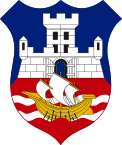
Beograd ima grb, ima tvrđavu Kalemegdan i spomenik koji se zove „Pobednik“. To su simboli Beograda. Belgrade has a coat of arms, it has the fortress Kalemegdan and a monument that is called „The Winner“. That are the symbols of Belgrade.
Belgrade, Serbia: Meet the Serbian Capital! 1 Belgrade, Serbia: Meet the Serbian Capital! 2

grb Beograda

Belgrade coat of arms

Pobednik

the Victor (winner)

The Story-Telling Technique 

Listening to stories that you’re familiar with can work wonders for your Serbian language learning. This is a powerful technique that will help you remember the vocabulary and absorb pronunciation.

If you liked this lesson, you will certainly enjoy learning Serbian at Serbonika, with many videos like this and other dialogues, texts, vocabulary, grammar explanations and exercises.

Serbonika

Najbolja metoda za učenje srpskog jezika

The best method to learn Serbian

The Serbian Language: Complete Review in 9 Key Points

The Serbian Language: Complete Review in 9 Key Points

Common mysteries about the Serbian language solved: Do the Serbs understand Russian? Is Serbian the same as Croatian and Bosnian? Is Serbian grammar complex?

Need a quick 0 boost? We get you approved instantly—no long wait, no hidden fees. Simply fill out the short online form, and if you’re eligible, the money lands in your account within minutes. It’s perfect for covering surprise bills or urgent expenses while keeping your credit score intact. get your 0 loan in minutes and say goodbye to stress—because life moves fast, and so can your finances.

You’ve probably heard some things about the Serbian language, but you’re not sure how to separate the truth from myth: Are Croatian and Serbian the same language? Is the grammar really that complicated? Is writing really that simple? Why do your Serbian friends seem unable to use the articles right? 

Hello and welcome, let me present you the Serbian language through 9 key points. 

#1 Serbian is a Slavic language.

It shares many common features with Russian, Czech, Polish, Bulgarian, Slovak, Slovenian, and all the other Slavic languages. All languages in the Slavic family have many similar words – just like the languages of the Romance family do (compare, for example, Spanish and Italian), and just like the languages of the Germanic family do (compare, for example, English and German).

Many people also ask if the Serbs can understand the Russians or Poles, or other Slavs. The answer is yes, to a certain degree. If we speak slowly, we will probably recognize and understand many words. We will survive in a Slavic country, we’ll easily get and transmit important information.

But, we won’t be able to have a long or deep conversation – unless the person we’re talking to has learned the Serbian language, or we have learned their Slavic language.


#2 Standard Serbian language is the same as Croatian, Bosnian and Montenegrin standards.

Things are different between the Serbs, Croats, Bosnians and Montenegrins. Our four standards are based on the very same dialect. Our languages are basically the same. We can even argue and joke and exchange ideas, with everyone speaking their own variant of the language. I wrote more on the subject in this article.

This similarity is the reason why the Serbian language is taught together with Croatian, Bosnian and Montenegrin at universities around the world. This is why they use the not so popular term BSCM for it.

If you want to read more about the exact differences between Serbian and Croatian, you can read the complete list of them in this article.


#3 Slavs can learn Serbian very quickly.

You bet they can! If you know a Slavic language, you have a huge advantage over non-Slavic speakers.

In fact, I speak almost exclusively Serbian from the very first class with any student that knows a Slavic language. In my experience, they can understand about 85% of what I speak.

However, sometimes they find it difficult to stop using their language’s grammar when speaking or writing Serbian. That’s their weak point.


#4 Serbian writing is simple.

That’s true – even though it hasn’t always been that way. It used to be quite complex, but it was reformed in the 19th century. What makes our writing complex today is the simultaneous usage of two scripts: Latin and Cyrillic. You can read more about all that in this article.

Today we have a phonetic orthography – that means we write as we speak. Each sound has it’s own letter and it’s very easy to learn. However, for some English speakers it’s quite challenging to stop reading and pronouncing Serbian the the English way. They need lots of practice to start reading the Serbian way automatically, and the best place to start is the Free Introductory Serbian Course we published on Serbonika.com.

Many Serbian learners avoid the Cyrillic script as it scares them in the beginning. But many insist on using it and end up reading it with ease. Here you can start learning the Serbian Cyrillic script, which is said to be perfectly adapted to the Serbian language.


#5 Serbian grammar is complex.

You bet it is. But let me first tell you what the Serbian language doesn’t have and what is difficult for us to learn in other languages:

  • Umlauts, in German or French. Pronouncing those sounds always twists our lips in a weird way and it feels silly!
  • Vowels between [a] and [e] (like in the word “can” or “hat”), or between [i] and [ə] shwah (like in “sin”). A typical Serb will simply pronounce them the Serbian way: [e] and [i].
  • Nasal sounds, like in French. They used to exist in the old language and they’re kept in Polish, but the Serbian language lost such sounds centuries ago.
  • Articles: definite (the) or indefinite (a, an). The most tricky part for us Serbs to learn in a foreign language! Even advanced English speakers will easily omit the articles. We just don’t feel the need to use them.
  • Conjunctive – it’s even difficult to understand the purpose of it.
  • Continuous tenses and so many verbal tenses that other languages have. We use our verbal aspects instead, to express the same meanings.

That’s why we have difficulties with these features when learning a foreign language. Especially the articles are something we struggle to learn and use properly. If I’m making mistakes in English, that’s usually in articles – and you’ve probably already noticed that!


#6 Gender equality is impossible in the Serbian language.

Are you a man or a women? In the Serbian language it makes a big difference, grammatically and lexically. We use different words and personal pronouns for men and women.

For example, if you’re male, you are my “učenik” (male student) and if you’re female, you are my “učenica” (female student). Masculine gender typically ends in a consonant, while feminine gender ends in -a.

This video will help you learn about masculine and feminine gender in Serbian. It’s perfect for beginners, and it’s a part of my FREE introductory Serbian course at Serbonika.


With such a sharp distinction, it is very difficult, almost impossible, to use a gender neutral speech. A general gender in Serbian, just like in many gender-aware languages, is masculine. If we’re adressing a group of people of both sexes, we have to use the masculine gender. Even if I’m talking about myself and my husband, I have to use the masculine gender. That’s how our language works!

Some people try to avoid this and to reffer to both sexes in one word. In their emails they’ll write: “dragi/e” (combining dragi – dear, masculine plural; and drage – dear, feminine plural). But it just looks silly!

Most professions have feminine and masculine form, but when talking about a profession, it’s normal to use the masculine gender. I am a woman and I am a female teacher (profesorica), but when desciribng my profession, I will often use the masculine word: profesor srpskog jezika (a Serbian language teacher).

Some professions were traditionally male and there were no feminine gender words to describe them. A few decades ago nobody had troubles with that. Today we’re creating new forms and they are becoming a part of our language. For example, psiholog was a traditional masculine form, used both for female and male psychologists. A few decades ago a new female form emerged: psihološkinja.


#7 The standard Serbian language has this set of specific features:

And here’s a tip for you: open your mind in terms of word order, as I explain in this video.


#8 You don’t need all of this grammar when you start learning Serbian!

Take it easy. For example, the most dreaded feature of the Serbian grammar are the cases. You don’t have to learn them all, especially in the beginning! If you’re not familiar with a language with cases, make sure you learn only 4 of them for the first 6 months or a year: Nominative, Accusative, Locative and Genitive. (I talk about them in this article about how to learn the Serbian cases.)


#9 Beginners should learn the Serbian grammar slowly and patiently.

It’s the best to take it easy. Learn it piece by piece and make sure to memorize lots of vocabulary. That will be of tremendous help. Learn to recognize two parts of a word: the root, that tells you the meaning, and the ending, that tells you what role this word plays in a context. Learn to recognize the root, and guess the function and meaning.

We take the grammar bit by bit, with loads of vocabulary and exercises at Serbonika. What’s even better, the Introductory Serbian Course is completely FREE and you can start learning immediately.

Serbonika

Najbolja metoda za učenje srpskog jezika

The best method to learn Serbian