Verb To Be in Serbian: Controversies Completely Explained

Verb To Be in Serbian: Controversies Completely Explained


Need a quick 0 boost? We get you approved instantly—no long wait, no hidden fees. Simply fill out the short online form, and if you’re eligible, the money lands in your account within minutes. It’s perfect for covering surprise bills or urgent expenses while keeping your credit score intact. get your 0 loan in minutes and say goodbye to stress—because life moves fast, and so can your finances.

In the Serbian language, verb “to be” is a controversial verb. It can cause disputes and fights and many confusions. Here’s an article that aims to resolve all your doubts about “glagol biti” (verb to be in Serbian).

“Biti ili ne biti, to je pitanje” – Do you recognize this quote? That’s how the famous line from Hamlet sounds in Serbian (“To be or not to be, that is the question”). And I open with this line because there is a serious dispute between linguists about the verb to be in Serbian. 

There are grammarians who argue that the verbal forms jesam, jesi, jeste, jesmo, jeste, jesu and their short variants sam, si, je, smo, ste, su are a distinct verb, separate from the verb biti and call it “the verb jesam”.

For them, the infinitive biti is only for the forms budem, budeš, bude, budemo, budete, budu.

Other grammarians follow the etymology of jesam and track its roots back to biti, considering the two different forms to be the perfective and imperfective aspects of this one verb.

That’s why in some textbooks and grammar books you will find the forms jesam and sam listed under the name glagol jesam, and in the others under the name glagol biti.

Don’t let them confuse you!


Since the meaning of all these forms can only be translated with the verb to be (or its corresponding counterparts in other languages, like: essere, ser y estar, εΙμαι, être, sein etc), we will consider all these to be different forms of a single verb whose infinitive is biti.


How to use verb to be in Serbian?


Verb biti is used to connect a subject with:

  • a pronoun: Moj brat je on. (My brother is he.)
  • an adjective: Moj brat je dobar. (My brother is good.)
  • an adverb: Moj brat je dobro danas. (My brother is fine today.)
  • another noun with preposition: Moj brat je iz Srbije. (My brother is from Serbia.)
  • another noun without preposition: Moj brat je moj prijatelj. (My brother is my friend.)

Or an adverb with another adverb: 

  • Danas je toplo. (Today it’s hot.) 
  • Ovde je zanimljivo. (Here it’s interesting.)

As an auxiliary verb, biti is used to form

  1. past tenses,
  2. future perfect tense and
  3. the conditional.

(New posts about these are being created, subscribe not to miss them!)

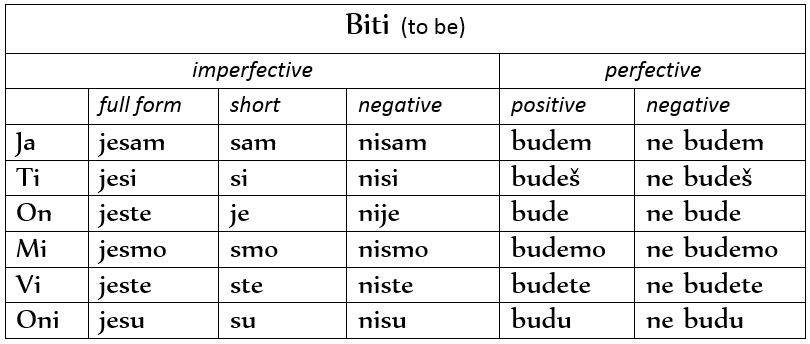
Now be a diligent student and grab your notebook. Here’s a useful table for you to copy:


All possible forms of Serbian verb to be in present tense
Verb To Be in Serbian: Controversies Completely Explained 1


Are you confused about when to use which of all these forms?

I know, you must be.

Here are the general guidelines:


When to use which form of verb to be?


1) In present or past, use the imperfective forms:

  • short positive forms (sam, si , je etc.) for positive sentences and
  • negative forms (nisam, nisi, nije etc.) when negating


Remember to use the the long forms (jesam, jesi, jeste etc.) only in these situations:

  • when you want to really emphasize the verb;
  • for answering (we often use jesam, jeste instead of „da“, as well as nisam, nije etc. instead of „ne“);
  • when asking questions* („Jeste li vi Amerikanci?“)

* Except for the third person singular, where we use the short form („Je li on Amerikanac?“ or colloquially „Je l’ on Amerikanac?“, which is also written “Jel on Amerikanac?).


2) The perfective forms are only used:

  • with modal verbs („želim da budem”),
  • with conditional conjunctions (ako, kad) and
  • in forming the future perfect tense (more on this soon).


But the Serbian verb to be can cause another confusion!

There is another verb with infinitive biti. It’s present tense stem is bije, and it means to beat!

So to the Hamlet’s dilemma “Biti ili ne biti”, a Serbian teacher can only respond:


“Biti ili tući – to je pitanje!” To beat or to hit, THAT is the question!

(Tući, tuče is actually a synonym of biti, bije.)


Whoa, hold your horses! 

Does this variety confuse you? I bet it does, but that’s normal. It’s only a sign that you should slow down and take it bit by bit. Go back to the beginning, and write notes in your notebook as you read the text again.

If you are a complete beginner, do not rush. Start with short and negative forms only (ja sam – ja nisam; ti si – ti nisi etc.). Learn it piece by piece and give yourself time to get used to the new language.

In the video bellow, I teach only pronouns and short forms of verb to be in Serbian, positive and negative, and only singular – to begin with. It’s a part of my Tako Lako Beginner Serbian Course, where everything is taught step by step.

First we need to set a solid basis, and then you’ll be ready to build on.
Serbonika

Najbolja metoda za učenje srpskog jezika

The best method to learn Serbian
3 Groups of Serbian Verbs: the Present Tense

Essentials of Serbian Verbs Conjugation: The Three-Faced Present Tense


Need a quick 0 boost? We get you approved instantly—no long wait, no hidden fees. Simply fill out the short online form, and if you’re eligible, the money lands in your account within minutes. It’s perfect for covering surprise bills or urgent expenses while keeping your credit score intact. get your 0 loan in minutes and say goodbye to stress—because life moves fast, and so can your finances.

My core lesson on Serbian Verbs. The Serbian present tense is both simple and complex. There are universal endings and only three types of verbs conjugation, but then it gets complicated…

Many Serbian language students are confused about the Serbian present tense. Beginner, intermediate and advanced, they often seem unsure about how to end a verb in third person singular or plural. And I can understand why and where the confusion comes from. So I decided to give you my core lesson on the Serbian verbs conjugation in the present tense. I will sum up all the information you need in a logical sequence that makes sense.  After this lesson, and some practice or a cheat-sheet, you will feel safe and confident using the Serbian verbs in present tense.

I like to start with the first two verbs anyone learns when they start learning Serbian, and often any other language:

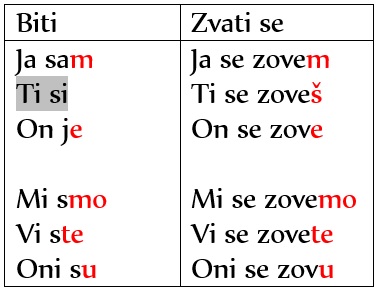
  • biti (to be), to say for example „Ja sam dobro“ (I’m fine), or “Ja sam Magdalena” (I’m Magdalena)
  • and zvati se (to be named), to say „Ja se zovem Magdalena“ (My name is Magdalena).

They are both irregular. But if you compare how they are conjugated, you will notice a consistency in the endings, in all persons except for the second person singular.

3 Groups of Serbian Verbs: the Present Tense 2

The 2nd person singular of the verb biti ends in –i, and this is a striking exception. 

It’s totally bizzare, because all the other Serbian verbs end in –Š for the second person singular of the present tense, just like you can see the in conjugation of the verb zvati se.


This is why we don’t use pronouns with verbs in Serbian


It’s the language economy. The endings that you’ve just seen are signals that show what is the Subject, or who we are talking about, who is doing the action. These endings are the reason why we omit pronouns.

The ending clearly indicates the subject, so there’s no need to repeat this information. That’s the language economy. 


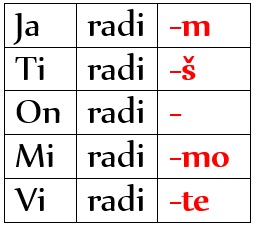
  • If a verb ends in –m, we always know that it’s about „ja“, the first person singular.
  • When we see or hear –š in the end of a verb, we know it’s about „ti“, you singular.
  • If there’s no consonant in the end, it’s about „on“ or „ona“, third person singular.
  • If a verb ends in –mo, we know it’s about „mi“, the first person plural.
  • When it ends in –te, we know it’s about „vi“, you plural.
3 Groups of Serbian Verbs: the Present Tense 3

These are universal endings for ALL Serbian verbs in the present tense.

There are only 3 exceptions, of which you’ve already learned one:

ti si (you are; second person singular of verb biti, to be)


The other two are also essential and important to learn:

ja hoću (I will, from the verb hteti, to will or want), and 

ja mogu (I can, from the verb moći, to can or be able)

Here, the first person singular oddly ends in –u. But if I tell you that it’s the normal way to conjugate in Russian (Я буду, Я иду) and even some Montenegrin dialects („viđu“ instead of „vidim“, I see), it will look less strange.


The Three Types of Serbian Verbs Conjugation

For the third person singular, the signal is actually the lack of an ending. (That’s why there’s only a dash and no ending in the table above.) It simply ends in a vowel -a, -i or -e, and no consonant.

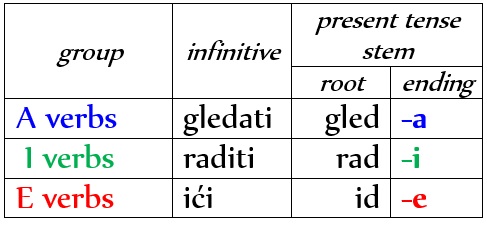
The third person singular is actually the present tense stem.

And based on how this stem ends, we can classify all the verbs in three groups:

3 Groups of Serbian Verbs: the Present Tense 4

Why is this so important?

Because in many verbs of the Serbian language the infinitive stem and the present tense stem differ significantly! But I’ll tell you more about that in just a minute.


Now let’s see what happens with the third person plural (they: oni, one, ona).

Here we can have three different endings, based on the third person singular (or the present tense stem):


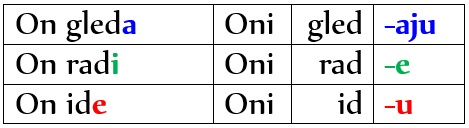
  • whenever the third person singular ends in –A, the third person plural will end in –AJU (on gleda, oni gledaju);
  • if the stem ends in –I the third person changes to –E (on uči, oni uče);
  • and when the stem ends in –E the third person changes that to –U (on pije, oni piju – just like in the verb to be: on je, oni su).


That’s what I call „the Law of the Third Person Endings“ when teaching Serbian verb conjugation:

3 Groups of Serbian Verbs: the Present Tense 5

This is the table that covers ALMOST ALL verbs in the Serbian language.


Now, why is this important?


Because many verbs have one stem in infinitive and a bit different one in the present tense!

This means that the infinitive doesn’t always tell us how to conjugate a verb in present.


For example, the infinitive of the verb zvati (to call) ends in –ati,

but the verb belongs to the E group,

and it gets an extra -o-,

so it goes: (ja) ZOVEM!


If an infinitive ends in –ati, that doesn’t necessarily imply that the verb belongs to the A group!


That’s why my rule of thumb for choosing your dictionary is to make sure that it includes both the infinitive and the present tense forms.


And that’s why I always teach the verbs in two forms, infinitive and present tense: zvati, zove

(zvati for infinitive, zove for the present tense stem)

What is the method to learn the three Serbian verb groups and how to keep them separated?

Simply by learning and practicing the verbs group by group, and building your vocabulary group by group, just like in the Serbian Verb Magic Course 


#1 Serbian Verbs Group: The E Verbs

In this video I’m explaining the first group of verbs that I teach after the verb to be: the E verbs:


Now, after all this, you must feel that you’ve learned a great deal about the Serbian verbs.

But you haven’t!

To really nail it, go back to the beginning of this text and read it with a pen and a notebook.

Write all the important information and draw the tables by your own hand.

Use Quizzes AND Workbooks in the Serbian Verb Magic course!


Then make a list of verbs and practice making sentences with them. Actually, you’ll need three lists: for A, I and E verbs conjugation.

Make at least three example sentences with all the verbs you’ve got:


1) for the first person singular (ja), because we always talk about ourselves,

2) for the third person singular (on, ona, ono), to get used to the different vowels in the end,

3) and for the third person plural, because the endings are different.


This is a useful exercise even for advanced students, because they are also often confused about the third person plural ending:

–AJU, –U, or –E.


Only having the information is not enough. Learning a language takes practice.

Serbonika

Najbolja metoda za učenje srpskog jezika

The best method to learn Serbian

7 Serbian Cases and How to Learn Them: The Declining Secret Revealed

7 Serbian Cases and How to Learn Them: The Declining Secret Revealed


Need a quick 0 boost? We get you approved instantly—no long wait, no hidden fees. Simply fill out the short online form, and if you’re eligible, the money lands in your account within minutes. It’s perfect for covering surprise bills or urgent expenses while keeping your credit score intact. get your 0 loan in minutes and say goodbye to stress—because life moves fast, and so can your finances.

Do you really have to learn all the Serbian cases, when learning Serbian as a foreign language? No, you don’t. (Let that relief sink in.) On the other hand: yes, you should. (And it’s not as difficult as it seams.)

My students sometimes ask me: “Do Serbs really always use the Serbian cases properly?”

Why would they ask such a thing? Because there is a myth spreading around claiming that some Serbian speakers (“less educated”) do not use the Serbian cases well.

That’s simply not true.

The reality is that in some Serbian dialects the case system is different. These dialects don’t use all the standard Serbian cases. But they obey their own rules. However, when speaking in a formal situation, a dialect speaker will normally conform to standard and use all the cases.

As a Serbian language learner, you don’t have to learn all the Serbian cases – but that won’t take you far. You’ll end up speaking “Tarzan” Serbian and you won’t be able to understand more than basic sentences.

If you decide to learn Serbian properly, do learn the Serbian cases. They’ll come in handy. But do not rush: learn them step by step. Otherwise you might end up confused and frustrated. (By the way, start with Serbonika’s Serbian language courses.)

In this article I’ll explain what cases are and how to learn the Serbian cases successfully.


What are cases?

Cases are different forms of nouns, pronouns and adjectives used for different purposes. There are 7 Serbian cases:

  1. Nominative,
  2. Genitive,
  3. Accusative,
  4. Locative
  5. Dative,
  6. Instrumental, and
  7. Vocative.

When you start learning Serbian, or another similar language, cases are usually the most challenging part of the grammar you need to understand and get used to.

If you already speak a language with cases, that’s great! But if not, let me explain what cases are based on your understanding of English. Because the English language still keeps remnants of the case system in its pronouns.

When you say „I love them“, I is the subject of your sentence and them is the object. If you want to reverse this statement, you can’t simply say *Them love I (!) – you have to use the proper case: They love me.

For subject, or to say who is doing the action, we use the Nominative case: I and they.

And for object, or who is receiving the action, we use the Accusative case: me and them.


The fun thing is that in Serbian we do this with ALL nouns, pronouns and adjectives: we decline them. To decline means to change a noun, pronoun or adjective for different cases.


In some languages (like German or Greek), what shows the case is mostly the article. In Serbian we don’t have articles, so we use endings of words to indicate the case.


Let me tell you 3 secrets about the Serbian case system

  1. Many students are horrified when they find out that we have 7 cases. But the truth is that you actually have 6 to learn, because Locative and Dative are actually the same! The difference in their form disappeared centuries ago.
  2. Instrumental plural looks exactly the same as Locative/Dative plural.
  3. Another truth is that you don’t really need the Vocative case, if that will make your life easier: it is used only to address people or invoke gods, nothing else.


That leaves us with 4.5 (four and a half) sets of case endings you need to remember.


Understand the Serbian cases from a practical perspective

When someone starts learning Serbian as a foreign language, they typically stumble upon the cases and rely on prepositions (on, to, at, with etc.) to convey meaning – because that’s what they do in their mother tongue.

That’s not the safest way, because prepositions with different cases create different meanings.

When my son was around 2 and he was learning to speak, I’ve noticed an interesting thing: he actually used the case endings to convey meaning! He didn’t use prepositions at all!

The first case he learned after Nominative was Genitive to say “mame” – shortend from “želim kod mame” (I want to go to mom).

His “with mom” sounded “mamom” in perfect Instrumental and without the preposition “sa” – and not ”sa mama”, what you might expect.

He’s experimenting with case endings. He will usually use the right ending for the meaning he’s trying to convey, but he might apply it to a wrong noun, or use the ending for plural instead of singular.

Slowly but steady, his brain is learning all these categories and sorting out the words and all the endings. He can still occasionally make a mistake, but that’s very rare.


That’s what cases are: meanings!

The cases are very important because they change meaning – just like prepositions in English alter meaning: “with me” is not the same as “about me”. You can get by with using prepositions only, you will be understood. But to understand Serbian, especially more complex sentences and texts, you need to learn the meanings and endings of the cases.


How to learn Serbian cases efficiently

The best strategy is to learn the cases one by one and little by little. There is so much data you need to remember, to learn how to use, and to get used to using, that it’s impossible to master it all at once and hectically.

You need to organize your thoughts around each category of nouns, pronouns and adjectives. You’re supposed to assign the right case endings to each category, and to learn how to use each case. You have to get used to using the cases and understanding them.

If this is your first language with declensions, you need to build new structures in your brain, and that takes time, but it’s worth it.


That’s why my advice is to learn the Nominative and the Accusative case only for the first month or so. Practice only with them, do a billion exercises with them, write and speak as many sentences as you can with them. Along with that, build vocabulary.

Only after you’ve mastered the Nominative and the Accusative case for many nouns, adjectives and pronouns, should you move on to add Locative. First alone, then combined and alternating.

You will get there, step by step. Do not hurry with trying to learn all the cases in a short period! You will only feel overwhelmed and frustrated. That’s simply too much, even for a Slavic speaker! Take one case at a time and build vocabulary. Learn one well before moving on to the next. Stick to 3, or at most 4 cases for the first half of the first year.


Learning like this, not only will you impress everybody with your right usage of the cases, you will actually build your brain! It will grow new synapses and pathways and become more powerful.

This is my Serbian-cases-teaching philosophy and this is how I’ve successfully taught many students. Now this method can be yours to use because it’s exactly how I teach cases at Serbonika – my online Serbian language learning platform:

  • First I explain the Nominative, without insisting on it – it’s just singular and plural of nouns.
  • Then I add a little bit of the Genitive, just to give you the taste.
  • Then it’s time to understand Accusative and start using it as direct object.
  • Finally, Locative is used to talk about locations.
  • Then we take a tour of the four cases again before moving on to the next one.


Learn these 4 cases very well, while building vocabulary as much as you can. Get used to using them and start feeling confident in controlled conversations. Only after that you should learn the other Serbian cases, even if it takes you a year!

Otherwise, they would only make a confusion in your head.

Serbonika

Najbolja metoda za učenje srpskog jezika

The best method to learn Serbian