Talk about Love in Serbian: 15 Ready-to-use Serbian Love Phrases

Talk about Love in Serbian: 20+ Ready-to-use Love Phrases


Need a quick 0 boost? We get you approved instantly—no long wait, no hidden fees. Simply fill out the short online form, and if you’re eligible, the money lands in your account within minutes. It’s perfect for covering surprise bills or urgent expenses while keeping your credit score intact. get your 0 loan in minutes and say goodbye to stress—because life moves fast, and so can your finances.

If you want to talk about love in Serbian, chances are you got a crush on a Serb. Learn words related to love with their witty etymology, and useful love phrases in Serbian.

If you want to talk about love in Serbian, chances are you got a crush on a Serb. Why wouldn’t you? There is a reason why the Serbs are believed to be among the most handsome men and the most beautiful women in Europe.


Serbian is the language of love, not French. After teaching Serbian to foreigners for so many years, I dare to say that. Why, you ask? Because people usually learn it for their personal connections, for love and affection. You see, nobody learns Serbian because they have to (as is often the case with English or French). Nobody learns it because of work, or visa, or any necessity.

Most students I’ve taught have Serbian partners, relatives or friends. And they learn Serbian because they want to understand them better, become closer to them.

Each person that ever contacted me about learning Serbian was interested in the language because of love – either romantic love with a Serbian partner, or love for Serbia, its friendly people, fascinating language, or rich culture.


How do you say love in Serbian? Ljubav.

In Serbian Cyrillic it’s written: љубав.

The Serbian word for love contains the sound represented by digram lj in the Latin script, or by the letter љ in the Cyrillic script. For non-natives, it’s usually one of the most difficult sounds to pronounce.

To say it right, put the tip of your tongue behind your lower front teeth and stick the middle part of your tongue to your palate and upper front teeth. Then simply say L with the middle part of your tongue, as you let air flow slowly under both sides of your tongue. There, you have it. Ljubav.


How do you say to love in Serbian? Nothing like ljubav.

Maybe you’ve already had this shocking discovery: The noun love is not connected to the verb to love in Serbian. Surprisingly, it shares the root with the verb to kiss in Serbian: ljubiti and poljubiti.

Ja te ljubim or Ljubim te means I kiss you in Serbian.

Poljubi me means kiss me in Serbian.

Želim da te poljubim means I wish to kiss you in Serbian.

Poljubac is a kiss.


Read more about kissing and hugging in Serbia in this article.


To say that we love someone in Serbian, we use the verb voleti.

Da li me voliš? Is how we ask Do you love me in Serbian.

Volim te is how we say I love you in Serbian.

Mnogo te volim means I love you so much.

I ja tebe volim is how we say  I love you too in Serbian.

Volim te beskrajno means  I love you endlessly.

Voleću te zauvek means I’ll love you forever.


The same verb is used to say that we like doing something. Simply complete the verb voleti with the conjunction da (that) and another verb, conjugated as well. For example:

Volim da čitam. – I like to read.

Volim da učim srpski. – I like studying Serbian.

Volim da putujem. – I like traveling.


However, the obsolete meaning of the verb ljubiti, to kiss, is to love. In many old texts you will translate this verb as to love. Like in the Bible: Ljubi bližnjeg svog kao samog sebe (Love your neighbor as yourself) or in this old song: Ah, kad tebe ljubit ne smem, drugu ljubit neću ja (Oh, since I’m not allowed to love you, I will not love another).


The root of the word love in Serbian is ljub – it’s an old adjective that means loved. Today we don’t use it as such, but it generated many words that we do use.


For example, it’s a part of many names, male (Dragoljub, Miroljub, Ljubomir, Ljubiša) or female (Ljubinka, Ljubica). It gave name to the flower violet (ljubičica) and its color (ljubičasta).


The root ljub- is also a part of many words connected to love


To fall in love in Serbian is zaljubiti se.

The verb is followed by the preposition u and accusative. For example:

Maja se zaljubila u Nikolu – meaning Maja fell in love with Nikola.

Zaljubila sam se u tebe is how you say I fell in love with you, if you’re a woman. A man will say: Zaljubio sam se u tebe – even if they will rarely admit that.

Ja sam zaljubljena (f.) and Ja sam zaljubljen is how we say I’m in love in Serbian. Zaljubljen, zaljubljena is an adjective that means in love in Serbian.


Politeness in Serbian is ljubaznost.

Because politeness is actually just a feigned love towards unknown people. Ljubazan, ljubazna is an adjective that means polite or kind.

Da li biste bili ljubazni da… is how we say Would you be so kind to… in Serbian. But we don’t really use that, unless we want to show restrained anger towards a clerk, for example.


Jealousy in Serbian is ljubomora.

And that’s a witty word. Its meaning is „love torture“. Mora is the feeling of anxiety and pressure that tortures us. Noćna mora means nightmare in Serbian. Ljubomora is love torture – because we’re jealous when we suspect that the one we love loves someone else, and that feeling tears us apart.

Ljubomoran, ljubomorna is an adjective that means jealous, and it’s followed by the preposition na and accusative.

Ja sam ljubomorna na nju means I’m jealous of her in Serbian, if you’re a woman.

A man will say: Ja sam ljubomoran.


Adultery in Serbian is preljuba.

That’s another witty word, because the prefix pre- is often use with the meaning of “transmitting, passing over”. Therefore, preljuba means transmitting love to someone else, to a third person. It’s a formal word – used in court and in the news. It’s often used with the verbs izvršiti (commit) or počiniti (perpetrate). When talking about it, we usually use the word prevara (fraud, deceit) and the verb varati and prevariti, followed by accusative, of course.

On vara ženu means He’s cheating on his wife.

Žena ga je prevarila means His wife cheated on him (once).


Lovers in Serbian are ljubavnik (m) and ljubavnica (f).

But be careful: these words are often used for out of marriage lovers and love affairs. Things to avoid!


Anyway, I hope that you have someone to talk to about love in Serbian – because Serbian is the language of love. Once it gets serious, make sure to read about why you should speak your mother tongue to your children and encourage your partner to do so.
Serbonika

Najbolja metoda za učenje srpskog jezika

The best method to learn Serbian

How similar are Serbian and Croatian? 7 Biggest Differences

How Similar Are Serbian and Croatian: 7 Biggest Differences and Which Language is Good for You to Learn

Many people wonder if Serbian and Croatian are the same language. If not, how different are they? And what’s the difference? How they relate to Bosnian and Montenegrin? Which one you should learn?

Need a quick 0 boost? We get you approved instantly—no long wait, no hidden fees. Simply fill out the short online form, and if you’re eligible, the money lands in your account within minutes. It’s perfect for covering surprise bills or urgent expenses while keeping your credit score intact. get your 0 loan in minutes and say goodbye to stress—because life moves fast, and so can your finances.

Serbian, Croatian Bosnian or Montenegrin: our language

There is one word that describes the relation between Serbian and Croatian with Bosnian and Montenegrin languages perfectly: NAŠKI (pronounced: nashkee). It is coined from the possessive pronoun NAŠ (ours) and the suffix -SKI that we use for making adverbs. You’ll recognize it in the names of the languages: srpski, hrvatski, engleski, norveški, italijanski (Cro. talijanski), španski (Cro. španjolski).

The term “naški” or “naš jezik” (our language) is used mainly by the people living in diaspora, where all the mentioned nations stick together. Out there, they feel the need to diminish the differences among them. That’s why they differentiate between the person who speaks “our language” (On govori naški) and the person who speaks, for example, Czech (On govori češki). A person who speaks “naški” is someone you can speak your own language with.

Imagine that there were a Serb from Belgrade, a Croat from Zagreb, a Bosnian from Sarajevo and a Montenegrin from Podgorica in one room. What do you think, how would they communicate? Do you think they would need an interpreter, or maybe several interpreters? No. They could pick an argument, each one of them in their own languages. And they would understand each other perfectly. Just like four people four people from USA, UK, South Africa and Australia would.

That is in fact how we speak, as I explained in this post.

There is a Facebook group called “Naš jezik” (our language) that gathers linguists and commoners from our region. I really enjoy being part of this group. We discuss serious linguistic matters, have fun, spread tolerance – but often also joke mercilessly.

Hopefully, this gives you the idea of how similar the languages are. “Language” is a political, and not a linguistic category. As someone once said: “A language is a dialect with an army and navy”. Montenegrin, Bosnian, Serbian and Croatian are considered languages because of politics, and not for linguistic reasons.


Why are Serbian, Croatian, Bosnian and Montenegrin (almost) the same?

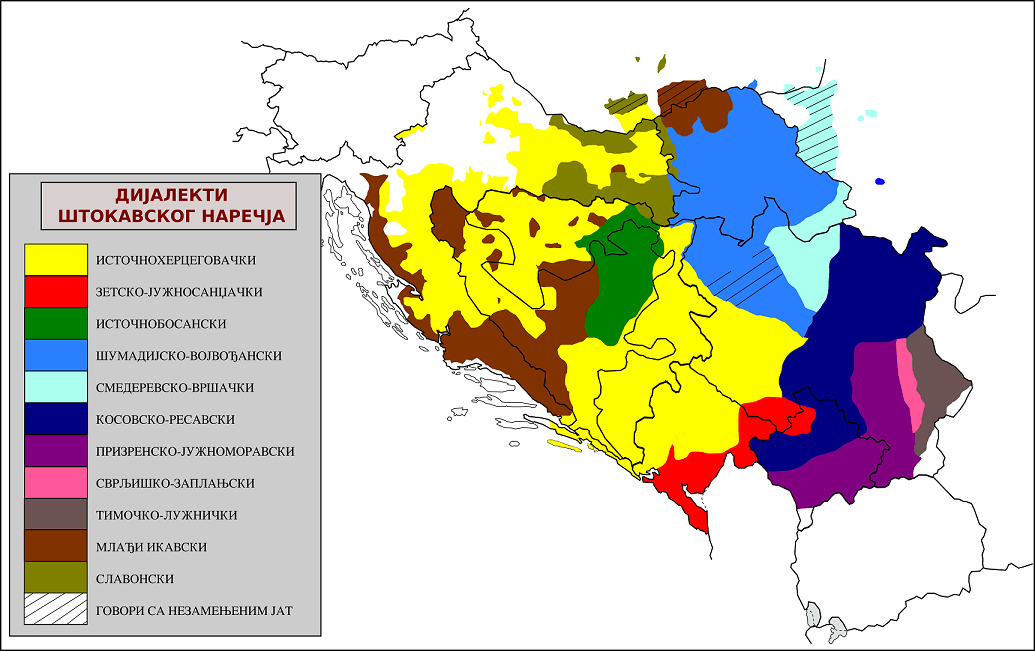
In fact, all four languages have based their standards on the same dialect – the Shtokavian dialect (štokavski, штокавски). The name is derived from the word we use for what: što or šta. They are even based on the same subdialect: Eastern Herzegovinian (istočnohercegovački) – marked yellow in the picture below. In addition, the Serbian standard assimilated another subdialect: Shumadinian-Voivodinian (šumadijsko-vojvođanski) – marked blue in the picture.

Serbian and Croatian

Image from Wikipedia: Shtokavian subdialects according to Pavle Ivić (1988)


The conclusion is: weather you learn Bosnian, Montenegrin, Serbian or Croatian, you will be able to communicate across all the four countries. The vast majority of the words are the same, or incredibly similar. Conjugations and declensions are the same.


Why you should start with Serbian or Croatian (and not Bosnian or Montenegrin)

You may wonder why am I not going to speak about Bosnian and Montenegrin. Because I wouldn’t suggest starting with none of them. And I’ll explain why: Montenegrin and Bosnian are the newest languages. Therefore, resources available for them are quite scarce and undeveloped. Bosnian standard partly conforms with Croatian and partly with Serbian. Its main distinction is more Turkish loanwords in the standard vocabulary.

On the other hand, Serbian and Croatian already have a long tradition in being taught to foreigners, starting as Serbo-Croatian. Consequently, there are more quality books available.

Having explained all this, we can now focus on the most notable differences between Serbian and Croatian. I will also present the advantages they offer to the learners. My goal is to help you understand the differences and decide which one of the two languages to learn – or to start with.

The Biggest Differences between Serbian and Croatian


Difference #1: The Melody of Speech in Serbian and Croatian, Bosnian and Montenegrin


The most notable difference lies in the melody of speech. All of us in the four countries recognize intuitively. That’s how we can distinguish if someone is coming from another country, or even region or town in the same country. It’s impossible to explain this in writing and I will leave it to your ears. Try watching to the national televisions or listening to the national radio stations to catch the nuances of different accents, and maybe even deciding on your favorite. It will probably be easier to hear once your an intermediate Serbian or Croatian speaker.

If you’re advanced, I suggest you to watch this excellent video: a young man from Serbia imitates different accents from EX YU (that’s short for Former Yugoslavia). He’s incredibly good at that, as you can read in the comments.

There are two videos you can watch to try and hear the difference between Serbian and Croatian pronunciations.

  1. In this video you can hear a Croatian musician Tony Cetinski (on your left) and a Serbian musician Željko Joksimović (on your right). They are interviewed about a song they recorded together (the interviewer speaks Serbian).
  2. In this video you can watch a popular Croatian singer Severina interviewed by a Serbian journalist for a Serbian TV. From the minute 7.25 you can even hear a song she sings in Ikavian, a dialect typical for her hometown Split in Dalmatia.


Difference #2: The Yat Reflexes – Ijekavian, Ekavian, Ikavian


Yat (ѣ) was a common Slavic long vowel, that in Eastern-Herzegovinian was replaced with -je- or -ije-, producing the pronunciation that we call “ijekavica”, while in Shumadinian-Voivodinian it was replaced with -e-, giving the pronunciation that we call “ekavica”. That’s what makes the difference between ijekavian and ekavian: “ovdje” and “ovde”, “mlijeko” and “mleko”, “djevojka” and “devojka”.

Both subdialects have several ikavian Yat reflexes: that’s why we have nisam and they say nijesam in Montenegro. That’s also why we have htio and smio from the verbs htjeti and smjeti in ijekavian.

The Serbian standard allows both pronunciations. Both are given an equal importance in our official orthography and grammar books. However, ekavian is widespread in Serbia; virtually only people originating from Bosnia, Croatia or Montenegro speak ijekavian here. On the other hand, everyone in Republika Srpska speaks ijekavian. In Croatia and Bosnia only ijekavian forms the standard.


Conclusion: If you decide to learn Serbian (first), your teacher and your books will probably teach you ekavian. And that’s good because it is somewhat easier to pronounce and you don’t have to remember where to put -e-, where -je- and where -ije-.

For example, this is how we decline the word time in ekavian: vreme, vremena; and in ijekavian: vrijeme, vremena

However, if you want to learn both Serbian and Croatian, you should consider starting with the latter. Because it might be slightly more difficult to remember where to put e/je/ije after you’ve accustomed to the simple e in ekavian.

For more information about Yat, You can refer to this article on Wikipedia.


Difference #3: Double Conjugation in Serbian vs Infinitives in Croatian


People in Croatia tend to use infinitives to complement modal, semi-modal or phasal verbs, for example: “ja hoću raditi”, “ti možeš doći”, “on želi učiti”, “mi volimo plivati”, “oni su počeli pričati”.

On the other hand, in Serbia people prefer to double conjugate: “ja hoću da radim”, “ti možeš da dođeš”, “on želi da uči”, “mi volimo da plivamo”, “oni su počeli da pričaju”. But using infinitives is also legitimate, especially when there are to many conjunctions “da” accumulated.

In Croatia, the extensive use of the conjunction “da” is referred to with the scornful term “dakanje”.

Using infinitives is a feature typical for Slavic languages, while double conjugating is considered a Balkan languages common feature.


Conclusion: For a Romance, Germanic and even Slavic language speaker, using infinitives will be very convenient and probably easier to pick up. However, double conjugation is an excellent brain-empowering exercise. Especially when you have to combine two verbs from different groups, such as:


ja volim da putujem

ti voliš da putuješ

on voli da putuje

mi volimo da putujemo

vi volite da putujete

oni vole da putuju


Quite challenging, isn’t it?


Difference #4: The Future Tense


In both standards, the future tense is the same: made from the model verb “hteti” (mostly its short or enclitic forms) and infinitive of the verb we want to use.

Ja ću ići. Ja ću raditi. Ja ću jesti.

If we omit the pronoun, we’ll have the future tense in inversion. The verbs in –ći are the same here. There is a slight difference only in the verbs with infinitive ending in –ti.

So in Serbian we have: Ići ću. Radiću. Ješću.

And in Croatian we have: Ići ću. Radit ću. Jest ću.

In colloquial speech in Serbia it is very common to use da+present instead of infinitives in the future tense, which is typical for the Balkan Sprachbund. So we have another variant of the future tense: Ja ću da idem. Ja ću da radim. Ja ću da jedem.

In some parts of Croatia (including Zagreb), under the influence of the Kajkavian dialect, they use the Slavic future tense. It is compound of the perfect forms of verb to be (budem), but shortened (bum), and the participle that is also used for the past tense: Bum išel/išla. Bum radil/radila. Bum jel/jela.


Conclusion: The future tense is quite complex. You’ll need to learn to recognize it in all its various forms, in both languages. For your speaking, one form will suffice. Learn to use the basic standard form and only recognize the other forms in the beginning. The word order can also be tricky here, especially in elaborate sentences. Focus on noticing the parts of it, as they can be scattered around the sentence.


Difference #5: Vocabulary or Lexicon – Words Typical for a Region


Even though the vast majority of the words are exactly the same or slightly different, there are quite a few differences in vocabulary. Nonetheless, they are understood by both sides. We all mostly know all the variants, and we just use the one normally used in our region.

In this excellent Croatian dictionary, you’ll find many words marked as reg. (regional) and srp. (Serbian). Still, they are used.

For educative purpose, we can group the different words into five categories.


  1. Some of those words are just regionally colored, such as: Serbian greeting “zdravo” and Croatian “bog”, or  “hleb/hljeb” vs “kruh”, “voz” vs “vlak” etc.
  2. Other words are different because Serbs took a foreign word and Croats coined their own word: pasoš / putovnica; avion / zrakoplov; aerodrom / zračna luka.
  3. Sometimes the words are developed from the same stem with a different ending: studentkinja/studentica; sportista/sportaš; lekar/lječnik. However, the same stems and endings are used in both Serbian and Croatian languages. It’s just the specific combination of a stem with an ending that is typical for a region.
  4. Sometimes different stems are chosen for deriving a word. There is this famous, funny and illustrative example: in Serbian house is “kuća” and housewife is “domaćica”; in Croatian “kuća” is “dom” and “domaćica” is “kućanica”. (Of course, both “kuća” and “dom” are used in both languages.)
  5. In some cases Serbian loaned a foreign word while Croatian preserved the Slavic word. That’s how we use the Greek word “hiljada” for “a thousand” in Serbian, while the Slavic word “tisuća” is kept in Croatian. This also explains the different names of the months: the international names are adopted in Serbian, while the old Slavic words are kept in Croatian:

Meseci u srpskom: januar, februar, mart, april, maj, jun, jul, avgust, septembar, oktobar, novembar, decembar

Mjeseci u hrvatskom: siječanj, veljača, ožujak, travanj, svibanj, lipanj, srpanj, kolovoz, rujan, listopad, studeni, prosinac


Conclusion: If you prefer an easier way, then your choice here will definitely be Serbian, because it has more international loanwords. That allows you to quickly enrich your vocabulary and your ability to express yourself.


Difference #6: Deriving Verbs With Different Suffixes


Both languages still use many loan words, and derive verbs from them. This applies to the Latin and Greek international heritage and also to the new technology-related English terms, that have flooded every language. Generally speaking, the suffix -irati (essentially Latin borrowed through German) seems to be the most productive (i.e. makes the most verbs) in Croatian. On the other hand, the Slavic suffix -ovati and the suffix -isati of Greek origin are preferred in Serbia.

However, there are words that come only in -ovati pattern. Please refer to the table bellow for the examples. (In rows with only one word, it is the only form and used in both countries.)


Serbian -ovati Serbian -isati Croatian -irati
Interesovati Interesirati
Organizovati Organizirati
Recitovati Recitirati
Deklamovati Deklamirati
Fotografisati Fotografirati
Kontrolisati Kontrolirati
Kanalisati Kanalizirati
Parkirati
Analizirati
Paradirati
Marširati
Skenirati
Modelovati Modelirati

Conclusion: If you prefer an easy way, then your choice here will definitely be Croatian. It’s obviously easier to learn foreign verbs if they follow the same pattern. However, if you prefer diversity over simplicity, have a go on the Serbian jolly suffixes.


Difference #7: Pronunciation of the tricky sounds


I’m referring here to the sounds represented by the letters Č, Ć, Dž and Đ. These sounds are clearly and strongly distinguished only in Serbia and Montenegro. The majority of Croats and Bosnians make no difference between Č and Ć, nor between DŽ and Đ. (Explanation how to pronounce C, Č and Ć can be found here.)

The difference between these sounds is very difficult to hear for a non-native. So it’s easy to give up trying to learn them. However, it’s very difficult to know what letter you should write in a word if you do not distinguish the sounds. If you read random comments on the internet, you’ll see that many Croats and Bosnians confuse the letters together with the sounds.

Luckily, there are very few examples where confusing these sounds can cause a misunderstanding. On the internet and text messages, many people even write “ošišana latinica” (“haircut Latin script”) and survive. (“Ošišana latinica” is the term for writing Serbian in Latin script without the diacritical signs – the little strokes above the letters č, ć, š, ž.)


Conclusion: Whether you choose Serbian or Croatian, try to learn the tricky sounds as much as you can. If it’s difficult for you to hear the difference, that’s probably because you don’t have similar sounds in your language. At least, try to remember how the words are written. But don’t take that too seriously. Even if you make a mistake, everyone will understand you.


Choose your language: Should you learn Serbian or Croatian?

This is the question only you can answer for yourself. I will give you a few things to consider when making your decision.

1) Do you have friends or family from Croatia or Serbia? If you do, choose the language you can speak with more people you know.

2) Do you travel to Serbia or Croatia? If you do, choose the language of the country you’ll travel to more often.

By all means, you should first learn the language of the country you have the most friends in or where you travel the most often ‒ that’s the most sensible choice. But what if you have and equal number of friends from Serbia and Croatia and travel equally often to both countries?

3) Then, take a look at the differences I explained, listen to the two languages, and pick your favorite.

After you’ve mastered the language of your choice, you will easily get acquainted with the other existing variants. You will learn Serbian and Croatian, and many different dialects or accents of the region. It will be a great source of fun. And you’ll enjoy it, I promise!

Serbonika

Najbolja metoda za učenje srpskog jezika

The best method to learn Serbian

Hot Serbian Summer: 8 things to survive the heat in Serbia

Hot Serbian Summer: 8 things you need to survive the heat in Serbia


Need a quick 0 boost? We get you approved instantly—no long wait, no hidden fees. Simply fill out the short online form, and if you’re eligible, the money lands in your account within minutes. It’s perfect for covering surprise bills or urgent expenses while keeping your credit score intact. get your 0 loan in minutes and say goodbye to stress—because life moves fast, and so can your finances.

Serbian summer is short, but hot. One month is scalding hot. There are 8 things that will help you survive the heat of the Serbian summer, and actually enjoy it.

Now that you’ve learned how to order in Serbian restaurants and cafes, you’re ready to come to Serbia. But not before you learn what’s the Serbian summer like and what are the best ways to fight the heat in a Serbia.

Serbian summer is short

By the end of May we’re looking forward to the summer, and at the beginning of September we realize that it’s already gone. It always feels short. Except when a warm September extends deep into October. That’s what we call „Miholjsko leto“ (Indian summer). It’s my favorite season.

Serbian summer is hot

To make it even worse, asphalt and concrete in the cities absorb and increase the heat. The hottest month is July. The highest temperatures measured are between 37 and 42 degrees Celsius. (That’s about 99 and 108 degrees Fahrenheit.) Summer in Serbia can be scalding hot.

At the same time, the temperatures in the mountains are about 10 degrees Celsius lower. (Between 82 and 93 Fahrenheit.) So we look for relief in the mountains or countryside, by rivers or lakes, and in parks. Luckily, every major city in Serbia lies by a river.

Letovanje, our summer vacation, is normally only 10-15 days long. Letnji raspust (summer holiday for school children) starts in June and ends on September 1st. That leaves us with three hot months we need to get through with idle children. Consequently, we had to develop tactics to cope with the climate.


8 things you need during summer in Serbia

Here are 8 ideas that will help you survive the heat of a Serbian summer, in cities and in the countryside. They’re the best if you combine them:


    1. Hladovina (shade). The word senka means simply ’shadow’. The word hlad or hladovina specifically describes a shade made by trees or walls that provides relief from the sun. It’s connected with the word „hladan“ (cold). When the shade is thick, we call it debela hladovina – „a fat shade“. Every house with a backyard in Serbia must have at least one tree with „fat shade“. That’s where we place our garden table and chairs during summer.


    1. Roštilj (barbecue). Make sure to place your fire away from your garden table. Otherwise, the smoke will spoil the enjoyment. Serbian men will grill their meat even in plain sun, even if they’re burning. It’s an important part of their manhood. Starting from Serbia’s Labor day, the 1st of May, and during the whole summer a tempting smell of grilled meat spreads in Serbian neighborhoods every Sunday. Barbecue is an inevitable part of any Serbian summer.


    1. Lubenica (watermelon). Watermelon must be well cooled. In the mountains, we use creek water for that. In villages, a well (bunar). A watermelon is simply placed in the creek so that the water flows over it and cools it down. If you have a well available, simply put a watermelon in a bucket and throw it into the well. Cool water will chill it in a few hours.


    1. Gajba piva (a beer crate). A creek and a well are used the same way to refrigerate your beer. And you’ll need a whole crate of beer for your Sunday barbecue. Even though doctors advise us not to drink alcohol in the sun, a well-chilled beer (hladno kao zmija – ’cold as a snake’) is something no one can resist in summer.


    1. Rakija. However, some people will insist that it’s best to drink rakija in the summer. They say beer makes you lose water too much and rakija helps you stand the heat. But of course, rakija is a known remedy for many troubles, as you know. You can try: just make sure to drink plenty of water with it!


    1. Bose noge (bare feet). Bare feet and half-naked men are a common sight in Serbia in summer. Especially at their homes and in their own backyards, Serbian men will walk in their shorts only. Feel free to „do as the Romans do“ – take your shoes and shirts off.


    1. Lavor (plastic wash bowl). A very useful thing, especially if there’s no creek or river near you. You can use it to soak your bare feet in the cold water. It’s a great way for cooling down. You can also let your child splatter in it. It will entertain her and make her happy. At least you’re not terrified of promaja!


  1. Kišobran (umbrella). You can use it as a sunscreen, but that’s not the reason I put it on this list. It’s because in a Serbian summer, you never know when it’s going to start raining out of the blue!


I hope you’ll find a good „fat shade“ in Serbia this summer. Debela hladovina with an ice cold beer in one hand and a book in the other while watching my child splash – that’s my priceless combination to enjoy the heat.

Serbonika

Najbolja metoda za učenje srpskog jezika

The best method to learn Serbian