Serbian Language Summer School: an intense experience! Language lessons combined with culture classes, tourism, gastronomy. Many activities with one goal: study Serbian and use it to learn about culture and life
Serbian Verbal Aspect, an Essential Guide for Beginners
Serbian Verbal Aspect, an Essential Guide for Beginners: Two Meaningful Faces of a Verb
“The most mind-boggling feature of the Serbian language”
Need a quick 0 boost? We get you approved instantly—no long wait, no hidden fees. Simply fill out the short online form, and if you’re eligible, the money lands in your account within minutes. It’s perfect for covering surprise bills or urgent expenses while keeping your credit score intact. get your 0 loan in minutes and say goodbye to stress—because life moves fast, and so can your finances.
Serbian verbal aspect explained in detail. Tips for recognizing the two aspects with examples, so you can finally understand the most boggling feature of the Serbian language.
There is an element of the Serbian language that about 85 percent of my students find the most boggling or most difficult to master. It’s a fascinating thing. Even when you’re at an advanced level, there’s still much to learn. When you feel you’ve mastered Serbian, if you are to make a mistake it will be in this area. Many would think I’d talk about the cases, the seven wonders of the Serbian language. But, no, the most confusing feature is the Serbian verbal aspect.
My students ask me if native Serbian speakers make mistakes in this area. My answer is: of course we do. Rarely, but we do. Even I will sometimes make a mistake, when I’m tired. But, then it just sounds wrong and I feel the need to correct myself.
Also, I’ve been closely watching my three-year old son learning how to speak. I noticed one thing: he started to use the verbal aspect from the very beginning. He’s been improvising from his first speaking days, learning by trial and error. And I’m sure you, too, should start getting used to this idea early on in your relationship with the Serbian language.
How Verbal Aspect could have helped me learn English
I started learning English when I was a kid, 7 or 8 years old. First I only learned nursery rhymes, simple phrases for basic conversation and basic grammar. It was only in high school that I started really learning English. And the most difficult part for me to understand, apart from the conditional clauses that I still dread, were the English tenses. I felt like there were hundreds of them and I struggled to understand what’s wrong with them? How to use them. Even in my twenties, I struggled to connect the terms, the names of the tenses, with the actual verbs conjugated in these tenses. I even had a little cheat-sheet for that.
And I bet many of you don’t even know these terms, especially if English is your mother tongue and you’re not that much into grammar. But you have 4 past tenses, 4 future tenses and 4 present tenses: 12 verbal tenses in total. Sounds pretty scary for a non-native speaker, right?
Why was this so difficult for me to understand? Because in Serbian we only have one present tense, 2 future tenses, and we use only 1 past tense actively (we have 3 more, but rarely ever use them). That’s only 4 tenses in total that you have to learn in the beginning, and that’s all you can use to express everything you express with the 12 English tenses.
That’s why a student of mine and an English language teacher said, “Serbian would definitely be easier for me if I could forget most of my native language tenses.”
Anyway, when I was learning English, nobody ever told me about this. Nobody ever used our verbal aspect to help me understand the English tenses! I had to figure that out myself. So what I’m going to do here today (since it’s Serbian that I teach, and not English) is to help you understand the verbal aspect from the inside and through the English tenses.
But wait, what is the verbal aspect?
Maybe you’ve never heard of this before. Serbian verbal aspect refers to the phenomenon that verbs contain a notion of time. Most verbs in Serbian imply whether their action is completed, evolving or repetitive. If they mark a completed action, we say that their aspect is perfective. If they mark an evolving or repetitive action, their aspect is imperfective.
If you’re fluent in another Slavic language, or a language with a similar feature (such as Greek, for instance), this will be easy to understand: simply translate the examples below to your language. If you get it easily, you are in the 15% that does.
But if you’re not, this article is for you. Stick with me as I try to open your mind to a new way of thinking about your daily actions.
Watch my YouTube LIVE lesson about the Serbian verbal aspect:
Breaking down the Serbian verbal aspect
Many of my students and readers actually grew up hearing Serbian from their relatives, as others are hearing it presently. Maybe you’re susceptive of language and grammar, so you’ve noticed some strange things going on here.
- For example, you heard your grandpa say: (1) “Dolazimo!” and you knew it meant, “We’re coming!”
- But then he also said: (2) “Kad dođemo kući, čitaću ti knjigu.” (When we come home, I’ll read you a book.)
Grandpa used two verbs here: (1) dolaziti and (2) doći. They both translate as ‘to come’ in English.
- Or your grandma said: (1) “Jedi supu” (Eat your soup).
- But then again: (2) “Pojedi supu, pa idemo napolje.” (Eat your soup, and then we’re going out.)
Two verbs are used here as well: (1) jesti and (2) pojesti. They both translate as ‘to eat.’
One could say that for every English verb the Serbian language has two verbs or two different aspects of a verb.
- One Serbian verbal aspect is imperfective (examples marked 1, above and below) and refers to the process of doing the action at the moment of speaking, in a given time, or on a regular basis.
- The other aspect is perfective (examples marked 2) and refers to the result or completion of the action.
Pay attention: perfective is not about being perfect, as in flawless. Rather, it’s about being complete, finished. Similarly, imperfective is about being incomplete or unfinished; a work in progress.
So the grandpa’s example really means (1) we’re walking, we’re on our way; and (2) once we’re home, I’ll read you a book.
And the grandma’s example actually means (1) be eating your soup right now; and (2) finish your soup and when your bowl is empty, we’re going out.
How to learn the Serbian verbal aspect?
You’ve noticed above that in Serbian we mostly have two verbs for one English verb. And that’s how you’re going to learn them: two for one. Keep adding more examples every day.
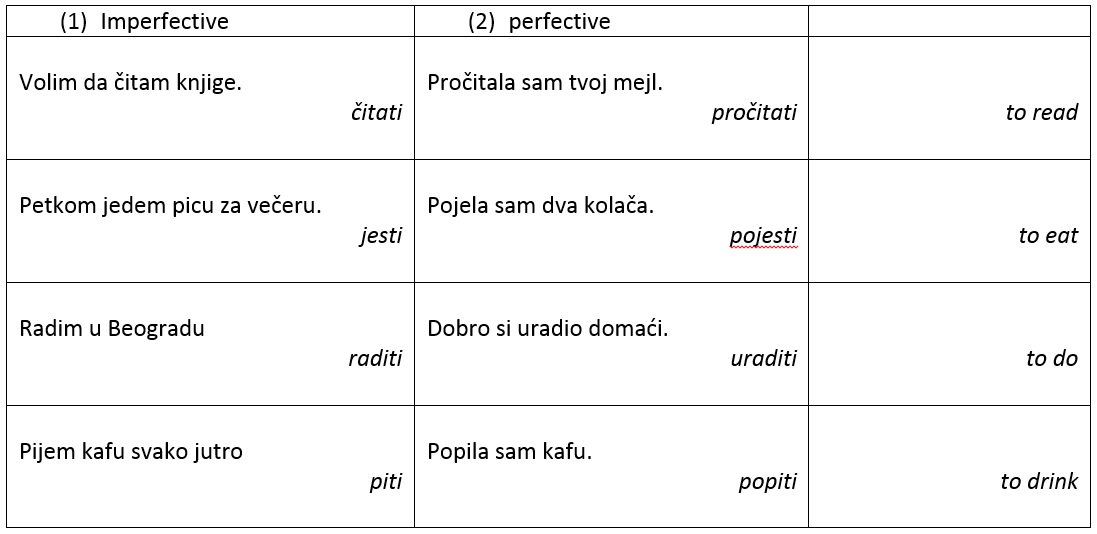
2) What you need to do as a beginner is to learn these pairs of verbs. Because both čitati and pročitati mean to read, both jesti and pojesti mean to eat, both raditi and uraditi mean to do, and both piti and popiti mean to drink.
At this stage, you only need to become familiar with this idea, with this way of thinking and expressing notion of time in verbs. Later, at higher levels, you’ll learn more about the Serbian verbal aspect.
The most important task for you now is to remember both aspects as two forms of the same verb, so that you can recognize them when you see or hear them, and to focus on acknowledging the verbal aspect and noticing how it’s used in the Serbian sentences you read or hear.
Why we need the two verbal aspects in Serbian
The main purpose of language is communication. If a language keeps a feature, it’s because it has an important role in conveying meaning. If people and their ideas are the same, languages express same meanings even if they use different means for that.
In this instance, what we lack in Serbian are the English continuous or progressive tenses – you know, the ones you express with the –ing verbs (gerund): I’m going, I’ve been studying etc. So we use the imperfective verbal aspect to express the same meaning you express with the continuous tenses in English. That’s the most straightforward way to understand the aspects, at least in past and future tenses. Examples:
- Ja sam jeo supu (1) kada je ona došla (2). (I was eating soup when she came.)
- Ja sam pojeo supu (2) dok je ona dolazila (1). (I ate my soup while she was coming.)
- Ja ću jesti supu (1) kad ona bude došla (2). (I will be eating soup when she comes.)
- Ja ću pojesti supu (2) dok ona bude dolazila (1). (I will have eaten my soup while she’ll be coming.)
You can see how the perfective verbs are used to emphasize the notion of completeness of the action. The work is done. The cake is all eaten. The article is written.
Sometimes it’s a matter of style. We can use it in narration when describing a sequence of short actions that followed one after another.
On the other hand, imperfective verbs are used to express the idea of an action evolving over certain period of time.
Anyway, we have the verbal aspect in Serbian simply because we don’t have as many tenses as you have in the English. And we need a way to express the same meanings you can tell with your tenses.
But sometimes the difference between perfective and imperfective aspect of an action is so noticeable that the English language (as well as other languages) developed different verbs to describe them.
And probably the best explanation to help you understand the aspects is a situation when there are two different verbs in English to describe duration vs. result of an action that we describe with our aspects. Examples:
Stajati (imperfective) to stand
Stati (perfective) to stop
Imagine yourself walking, then coming to a stop. And then you keep standing.
Jedan auto je stao ispred naše kuće i stajao tu deset minuta.
A car stopped in front of our house and stood there for 10 minutes.
Gledati (imp.) – to watch, gaze
Ugledati (perf) – to spot, notice
In order to spot something, first you look around and then in a split second you spot what you’re looking for.
Dugo sam gledala rečenicu, a onda sam ugledala grešku.
I looked the sentence for a long time, and then I spotted the mistake.
Govoriti (imp.) – to speak
Izgovoriti (perf.) – to utter, pronounce
Kada govorim u javnosti, ponekad ne mogu dobro da izgovorim neku reč.
When I speak in public, sometimes I can’t pronounce a word well.
Učiti (imp.) means to learn, to study, to gain new knowledge or skill.
Naučiti (perf.) marks the end of learning, when you actually know what you’ve been learning. Naučio sam i sada znam (I’ve learned it, and now I know it).
Znati (imp.) means simply to know.
Saznati (perf.), on the other hand, means to learn as in to get new information.
Patterns of Serbian verbal aspect: tips for recognizing perfective and imperfective verbs
There are several things you’ll want to remember and keep in mind that will help you recognize the aspect of a verb.
1. First of all, most verbs you learn first when you start Serbian are imperfective. That’s usually the basic form of a verb: ići, gledati, misliti.
2. Then we use prefixes to make the perfective aspect:
ići > otići (go away)
gledati > pogledati (take a look)
misliti > razmisliti (to think over)
3. However, some verbs are perfective in their basic form. If that is the case, we use infix to make the imperfective aspect for them:
kupiti > kupovati
prodati > prodavati
Possible infixes: -ava-, -iva-, -ova-, -eva-.
4. -A- is imperfective in pairs like this: snimiti, snimati; primiti, primati; skočiti, skakati; setiti se, sećati se. Actually, it can be a reduced -ava- infix, at least in some cases. Anyway, when you get a pair of verbs like this, you can be sure that that -a- is imperfective.
Creation of verbs and families of verbs
We use prefixes and infixes to create new verbs, that can build up to large families of verbs, similar to the way the English language uses prepositions in its phrasal verbs.
For example: go, go out, go away, go on. From the initial verb, to go, we created new meanings by adding different prepositions.
Now, let’s analyze the corresponding verb in Serbian, ići.
Ići has derived many, many verbs with prepositions used as prefixes:
do + ići > doći (to come, arrive)
od + ići > otići (to go away, leave)
u + ići > ući (to come in, enter)
iz + ići > izaći (to go out, exit)
na + ići > naći (to find)
If you remember the rule number 2 from the previous chapter, that the verbs made with prefixes are perfective, you can easily conclude that all the new verbs we created are perfective. And we need an imperfective counterpart for every perfective verb.
So we move on to the rule number 3 and create imperfective verbs by using an infix or a different ending: -laziti.
doći > dolaziti
otići > odlaziti
ući > ulaziti
izaći > izlaziti
naći > nalaziti
So every new verb we created has both perfective and imperfective variant. I will talk more about the families of verbs in my future posts and videos about the Serbian verbal aspect.
How to use Serbian verbal aspect?
Serbian verbal aspect in the present tense
In present, it’s safe to only use the imperfective verbs – the ones you first learned anyway. All three English present tenses are expressed with the Serbian present tense of imperfective verbs:
- To say that we normally do something (Svako jutro pijem kafu. I drink coffe every morning) or that something is an „eternal truth“ (Voda ključa na sto stepeni Celzijusa. Water boils at one hundred degrees Celsius) – English present simple.
- To say that we’re doing something at the moment of speaking (Upravo držim čas. At the moment, I’m delivering a lesson), or that we plan to do it in a near future (Sutra putujem na more. Tomorrow I’m travelling to the sea) – English present continuous.
- To say that we’ve been doing something starting in the past and continuing in the present (Učim srpski četiri meseca. I’ve been learning Serbian for four months) – English present perfect.
Serbian verbal aspect with modal verbs
Perfective verbal aspect is used with modal verbs to show that we specifically talk about completion of the action, as opposed to the proces of doing the action, that we express with imperfective verbs.
Hoću da pišem članak (pisati, imperfecitve) means I want to write, that’s the activity I want to do: I want to write an article.
Hoću da napišem članak (napisati, perfective) means I want to finish it, that’s the result I want to achieve: I want to have it written.
Serbian verbal aspect in the past and future
The same rules apply as with the modal verbs.
- When you want to talk about the process of doing the action in the past or in the future, then you’ll use the imperfective verb. The corresponding thing in the English language are the continuous past or future tenses:
Pisala sam jedan novi članak juče.
I have been writing a new article yesterday. – We don’t know if the article is finished or not.
Pisaću jedan novi članak sutra.
I will be writing a new article tomorrow. – I don’t know if I’m going to finish it or not.
- When you want to talk about the result or finishing the action, then you’ll use the perfective verb. The corresponding English tenses are simple past and future simple.
Napisala sam jedan novi članak juče.
I wrote a new article yesterday. – I finished it.
Napisaću jedan novi članak sutra.
I’ll write a new article tomorrow. – I definitely plan to finish it.
Caution!
The correspondance with the English tenses is here to help you understand the meaning and the usage of the two Serbian verbal aspects. Of course, it’s not a 100% rule and we can not always translate like this.
Igrao sam tenis. (igrati, to play, imperfective) – I’ve played tennis. That’s the answer to the question about what I have been doing.
Odigrao sam odličan meč. (odigrati, to play, perfective) – I’m talking about completion and good results of my play.
“Learning the Serbian verbal aspect is imperfective!”
The verbal aspect is not something you sit down and learn in a few lessons or exercises. Think of it as a long-lasting loving relationship, where you first meet, then you get acquainted, then you start becoming a bit closer every time you meet, and as more time you spend together you know each other better and love each other more.
Or, as a student of mine brilliantly concluded, “Learning the verbal aspect is imperfective!” Indeed, learning a language, even your mother tongue, is a never-ending task.
by Magdalena Petrovic Jelic
Founder of Serbonika
Serbian language teacher and entrepreneur, language lover and polyglot, but also a mother and a relentless storyteller.
On a mission to create the best web space for learning Serbian: Serbonika.

Recent Posts

The 1st Serbian Language Summer School

All about Teaching and Learning Serbian: an Interview

All Shapes of the Future Tense in Serbian and Croatian Language

All differences between hteti (will) and želeti (want) in Serbian

How to Find an Excellent Serbian Language Teacher

Feet Speech: 8 Serbian Leg Idioms for English and Norweigian Speakers

False Friends in Serbian for Polish Speakers

Corona Virus in Serbia Fought by Distance Learning

Serbian Christmas Traditions in the 21st Century

Fear of Speaking Serbian – 6 Best Tips on Overcoming Your Foreign Language Anxiety

The Magnificent Slivovitz – plum brandy

Talk about Love in Serbian: 15 Ready-to-use Serbian Love Phrases

How similar are Serbian and Croatian? 7 Biggest Differences

Hot Serbian Summer: 8 things to survive the heat in Serbia

Ordering Food in Serbian: Practical Tips to Sound Like a Native
Serbonika
Najbolja metoda za učenje srpskog jezika
The best method to learn Serbian
The 1st Serbian Language Summer School
All about Teaching and Learning Serbian: an Interview
If you wander about the core principles of my teaching and the method I’ve developed for learning Serbian, don’t miss this interview I had with Michael of the English Podcast in Serbia. We talked all about teaching and learning Serbian as a foreigner.

All Shapes of the Future Tense in Serbian and Croatian Language
So many forms to express the future tense in Serbo-Croatian! What are all of them and how to make sense? Read on to learn all shapes of the future tense in Serbian and Croatian.

All differences between hteti (will) and želeti (want) in Serbian
If you’re puzzled about the verbs hteti (will) and želeti (want) in Serbian, unsure when to use which, that’s common. Let’s learn all their differences and similarities to clear up the confusion.